
Philippines staffing research · Updated
Continuity-drill evidence for Philippines outsourcing
Research on whether a cross-border outsourced operations queue can continue safely when its primary operator, tool, or handoff window is unavailable.
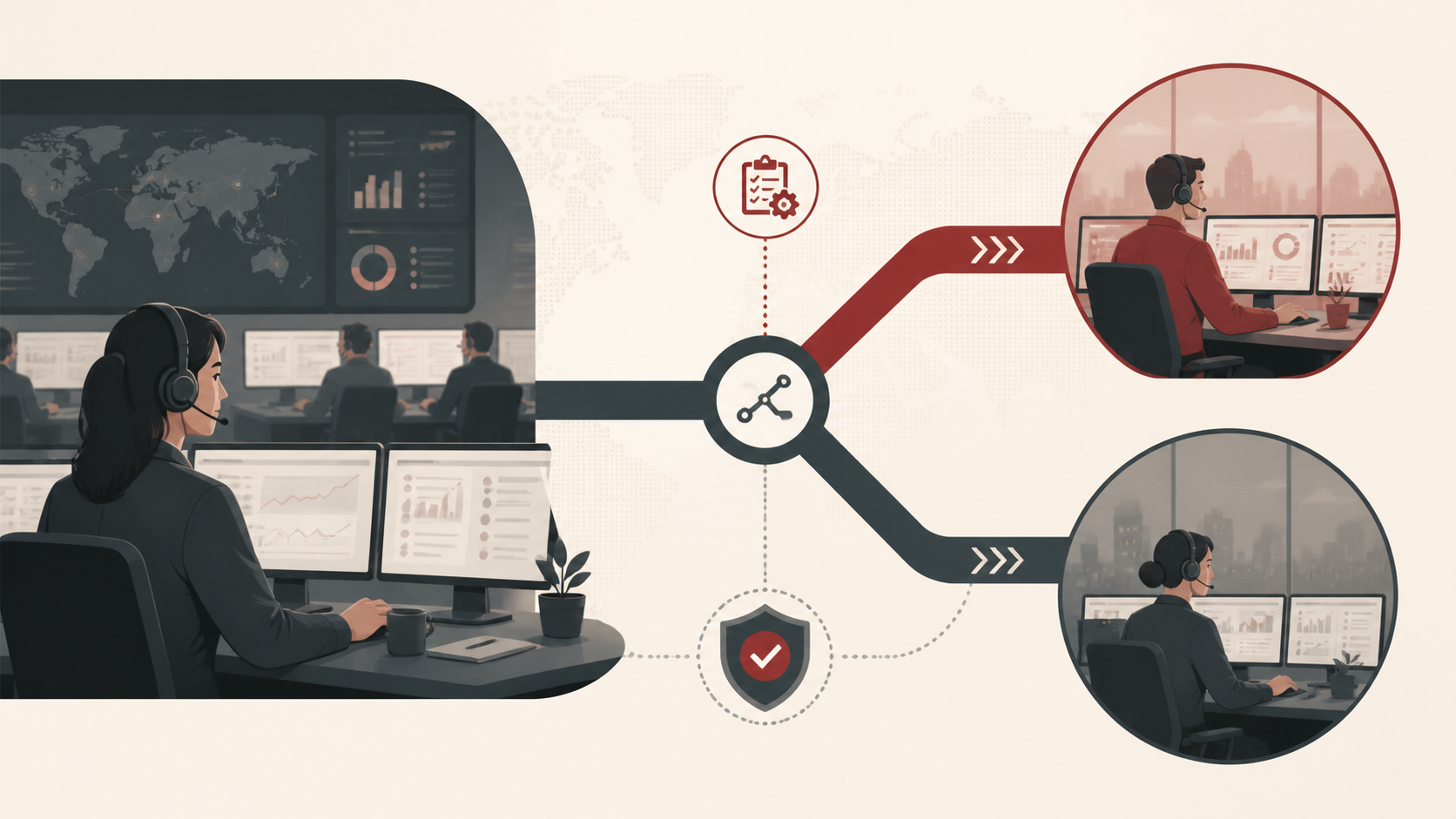
Research question: what does a continuity drill prove about a Philippines-based outsourced operations queue, and what remains unknown after the exercise? The answer depends on testing a specific service, dependency, owner decision, and recovery condition rather than declaring a whole business resilient.
Methodology and route-local sources for the 2026-08-21 review: choose one bounded interruption scenario, record the pre-drill queue and dependencies, observe detection, notification, safe completion, pause, owner decision, and reconciliation times, then compare findings with the stated stop rules. The drill design was checked against https://csrc.nist.gov/pubs/sp/800/34/r1/upd1/final, https://www.nist.gov/publications/nist-cybersecurity-framework-csf-20, and https://www.nist.gov/privacy-framework. These sources frame continuity and protection questions; they cannot establish recovery capability beyond the tested scenario.
Evidence scope: define the queue, normal source, fallback source, authorized relief role, communication channel, maximum acceptable delay, and stop conditions. NIST continuity and cybersecurity guidance can structure the questions; it cannot certify a company’s recovery capability or the suitability of a particular provider.
Select a scenario that could actually interrupt work: an absent operator, unavailable application, lost source file, time-zone gap, or changed policy. State what is simulated and what is not. Do not create a live outage, alter customer records, or test by submitting a public form.
The drill packet should contain redacted examples, the current queue definition, access map, escalation contacts, source versions, and a decision log. The relief operator should be able to distinguish work that can continue from work that must wait. A copied checklist without source ownership is not a recovery capability.
The outsourced role may acknowledge the interruption, preserve the queue state, complete pre-approved low-risk work, and route exceptions. The internal owner decides whether service promises change, whether a fallback tool is safe, whether priority changes, and when normal work resumes.
Measure time to detect, time to notify, items safely completed, items paused, missing context, access failures, owner decisions delayed, and recovery of the authoritative record. Report the scenario and workload. A drill with five easy items does not prove capacity for a peak queue.
A successful drill includes safe non-action. If the fallback lacks a current source, the correct result may be to hold the item and record why. Penalizing every pause creates pressure to guess during a real interruption. Review whether the stop rule was understood and whether the owner responded within the stated window.
Cross-border continuity includes handoff timing. UTC+8 coverage may overlap only part of an owner’s day, and a local holiday or connectivity problem can change the path. Put the timezone, next contact window, and relief authority in the record. Never rely on an assumption that someone will be online.
After the exercise, separate process failure from tool failure, missing training, unclear authority, insufficient staffing, and unrealistic recovery targets. Assign a repair owner and due date. A drill is evidence only when findings remain visible after the meeting and are retested.
The Philippines setting should be treated as one operating condition among many: location, shift, language, connectivity, provider structure, and local labor arrangements may affect the scenario. None proves a person’s resilience or a provider’s ability to cover every event. Test the actual role and dependency chain.
Interpretation: a bounded continuity drill can reveal whether a queue has enough documented context for safe relief and owner escalation. It cannot prove disaster recovery, cybersecurity, legal compliance, customer acceptance, or performance under every outage. Keep the claim at the level of the tested scenario.
Limitations include artificial behavior during an announced drill, incomplete dependency maps, unavailable audit logs, and a scenario that is less severe than real demand. A successful exercise may also reveal that recovery depends on one untested administrator. Repeat after a material change in tool, team, queue, or service promise.
A drill report should identify the last known good state, not only the time work resumed. The queue may reopen while records remain duplicated, owner decisions remain unlogged, or a fallback file has become authoritative by accident. Recovery is complete only when the source of truth and the outstanding exceptions are reconciled. Record which items were intentionally held and which were processed under fallback authority. That distinction gives the owner a way to audit the boundary later instead of relying on a broad statement that the queue was restored. The exercise should finish with a small reconciliation: compare the pre-drill queue, fallback activity, and restored system, then list every item that needs owner confirmation. That final check is evidence of recovery quality, not administrative decoration.
The relief path should be exercised at least once by someone who did not write the original procedure. That reveals hidden assumptions about bookmarks, permissions, abbreviations, and local knowledge. Ask the relief operator to narrate where they stop. Their questions are evidence about documentation quality, not a failure of initiative.
Continuity decisions also have a communication cost. Customers or internal teams may receive different timing language during a disruption. The owner should approve any changed promise and provide a dated message source. The outsourced role can prepare the queue and use that approved message, but should not invent reassurance to make the backlog appear smaller.
The owner should state whether the target is continued processing, preserved evidence, customer communication, or a safe pause; these are different recovery outcomes. A relief operator can meet one while another remains unresolved. Record the outcome separately so a short interruption is not reported as full continuity. Include the time when the owner accepted the restored state and the exceptions that remained open. This makes the drill comparable with a later exercise without pretending that two unlike incidents had the same severity. Conclusion: choose one queue, one interruption, one relief path, and explicit stop rules. Preserve the evidence and repair the dependency that caused delay. Expand only when another authorized person can continue the safe work and the owner can make the decisions the fallback cannot.